Asaph Nyakikuru – From Uganda’s Battlefields to the Command of the Special Forces

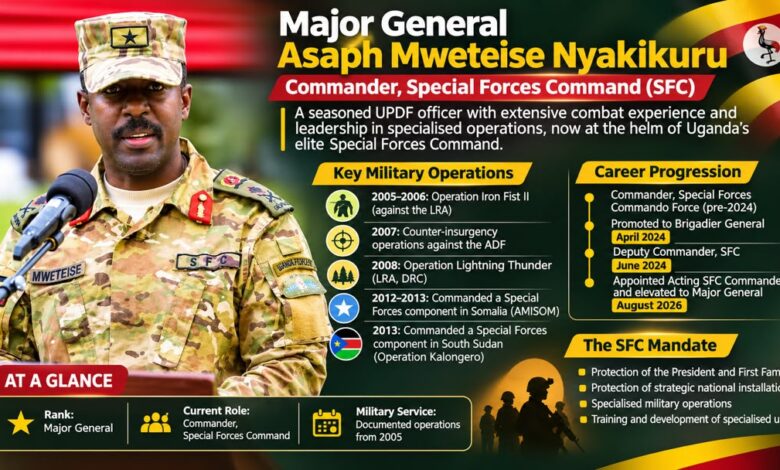
Uganda’s Special Forces Command (SFC) is now under the leadership of Major General Asaph Mweteise Nyakikuru, a military officer whose career has taken him through counter-insurgency campaigns, regional deployments and the command of specialised military formations. His rise offers a glimpse into the individuals and institutions at the heart of Uganda’s security establishment.
Within Uganda’s security establishment, few military positions carry the strategic weight and responsibility associated with commanding the Special Forces Command.
The institution sits at the intersection of national security, presidential protection and specialised military operations. Its commander oversees a formation whose responsibilities extend beyond conventional battlefield engagements to include safeguarding the country’s leadership and strategic installations.
Since August 2026, that responsibility has rested with Major General Asaph Mweteise Nyakikuru.
His appointment marked the culmination of a military career spanning more than two decades of documented operational experience, including assignments in Uganda, Somalia and South Sudan.
Unlike officers whose careers have been defined primarily by administrative command, Nyakikuru’s progression has largely been rooted in the specialised operations structures of the Uganda People’s Defence Forces (UPDF).
His journey from commanding commando formations to leading the entire SFC provides insight into the development of Uganda’s military leadership.
A Career Forged in Military Operations
Nyakikuru’s documented operational history dates back to 2005, when he participated in Operation Iron Fist II, a military campaign against the Lord’s Resistance Army (LRA).
The operation formed part of Uganda’s prolonged effort to dismantle Joseph Kony’s insurgency, which had devastated communities across northern Uganda and spread into neighbouring countries.
In 2007, Nyakikuru took part in counter-insurgency operations against the Allied Democratic Forces (ADF) around the River Semliki area in western Uganda.
A year later, he was involved in Operation Lightning Thunder, the UPDF campaign targeting LRA bases in Garamba Forest in the Democratic Republic of Congo.
These operations represented some of the earliest documented chapters of his military career, exposing him to the realities of counter-insurgency warfare and cross-border military operations.
His record of service is reflected in a 2021 proposed national honours roll submitted by the UPDF Joint Chief of Staff. The document credits him with command responsibilities in subsequent regional deployments.
Somalia: Commanding Uganda’s Special Forces Abroad
Between 2012 and 2013, Nyakikuru commanded a Special Forces component under the African Union Mission in Somalia (AMISOM).
At the time, Somalia was battling a deeply entrenched Al-Shabaab insurgency, with African Union forces supporting efforts to restore stability and government authority.
Uganda was among the leading troop-contributing countries, participating in operations aimed at reclaiming strategic towns and territories.
Official military records credit Nyakikuru’s unit with contributing to the pacification of major towns in the Lower Shabelle region.
The deployment was a significant chapter in the development of Uganda’s specialised military operations, requiring coordination with regional forces and the ability to operate in a complex security environment.
South Sudan: Operation Kalongero
Another defining assignment came in December 2013, when civil war erupted in South Sudan.
Fighting between forces loyal to President Salva Kiir and those aligned with his former deputy, Riek Machar, threatened thousands of civilians, including Ugandans living and working in the country.
Uganda deployed troops under Operation Kalongero to secure strategic locations and facilitate the evacuation and protection of its citizens.
Nyakikuru commanded a Special Forces component during the operation.
His official military citation credits the unit with providing safe passage for Ugandans trapped by the conflict and contributing to operations in Bor Town.
The Somalia and South Sudan deployments stand out because they involved command responsibilities beyond Uganda’s borders, adding valuable regional operational experience to his military record.
Building the Commando Formation
As his career progressed, Nyakikuru became increasingly associated with the development of specialised commando units within the UPDF.
He served as Commander of the Special Forces Commando Force and oversaw Camp Rufu in Kiruhura District, home to the One Commando Battalion and a specialised training centre.
The facility focuses on developing commando capabilities, including sniper training.
One of the most significant developments during his tenure was the expansion of the commando formation.
In 2021, President Yoweri Museveni announced the elevation of the First Commando Battalion into a brigade, expanding its organisational structure and command capacity.
Nyakikuru was in command of the formation during this period.
The experience placed him among the leaders responsible for developing the manpower, training and organisational capabilities of the UPDF’s specialised commando units.
It also preceded his rise into the senior leadership of the broader Special Forces Command.
The Move Into Senior SFC Leadership
In April 2024, Nyakikuru was promoted from Colonel to Brigadier General.
Two months later, President Museveni appointed him Deputy Commander of the Special Forces Command, replacing Brigadier General Charity Bainababo, who had been assigned to the National Defence College.
He assumed the role under Major General David Mugisha, then Commander of the SFC.
As deputy commander, Nyakikuru was involved in the institution’s leadership, administration and professional development programmes.
His public engagements included presiding over military promotion ceremonies and addressing officers on discipline, leadership and responsibility.
In August 2024, he presided over the decoration of 104 SFC officers promoted to various ranks.
He described promotion as recognition of commitment, hard work, mastery of duty and leadership ability, while reminding officers that advancement comes with greater responsibility.
These duties offered a glimpse of his leadership beyond the battlefield, particularly in strengthening the command’s internal leadership structures.
August 2026: Taking Command of SFC
Nyakikuru’s rise reached another milestone on 3 August 2026, when Chief of Defence Forces General Muhoozi Kainerugaba appointed him Acting Commander of the Special Forces Command.
The appointment followed the planned departure of Major General David Mugisha for strategic military studies at the National Defence College abroad.
Nyakikuru was simultaneously elevated to the acting rank of Major General, with both the appointment and promotion taking immediate effect.
The transition placed him at the helm of an institution he had served in various capacities, first as commander of specialised commando formations and later as deputy commander.
By September 2026, he was already presiding over senior command activities, including the decoration of 62 officers following their promotion.
The UPDF’s current leadership directory lists him as Commander of the Special Forces Command.
The Institution Behind the Position
To understand the significance of Nyakikuru’s appointment, it is important to understand the institution he now leads.
The Special Forces Command traces its roots to the High Command Unit established in 1981 during the National Resistance Army’s guerrilla struggle.
Following the NRA’s capture of power in 1986, the unit became the Presidential Protection Unit. It later expanded its responsibilities before becoming the Special Forces Group in 2010 and the Special Forces Command in 2012.
According to the Ministry of Defence and Veteran Affairs, the SFC is tasked with conducting specialised missions and operations at short notice.
Its responsibilities include protecting the President and First Family, safeguarding strategic installations and developing specialised military capabilities.
It is therefore an institution whose mandate extends into some of the most sensitive areas of Uganda’s national security architecture.
Nyakikuru succeeds a line of senior officers who have commanded the formation, including General Muhoozi Kainerugaba, Major General Sabiiti Muzeeyi Magyenyi, Major General Don Nabasa, Major General Felix Busizoori and Major General David Mugisha.
Nyakikuru’s publicly documented career provides a clear picture of his progression through operational and command responsibilities.
From counter-insurgency campaigns in Uganda and deployments in Somalia and South Sudan to commanding specialised commando formations, much of his documented military career has been spent within the UPDF’s special operations structures.
His elevation to command of the SFC places him among the senior military officers occupying key positions within Uganda’s security establishment.
For a man whose career has largely unfolded within military ranks, the position brings a new level of institutional responsibility and public visibility.
As Commander of the Special Forces Command, Nyakikuru now leads an institution central to Uganda’s specialised military operations and presidential security architecture.
His journey from the battlefield to the command headquarters in Entebbe marks another chapter in the evolution of Uganda’s military leadership.