
CDF takes interest in allegations surrounding strategic telecommunications, digital infrastructure and public contracts linked to the businessman.
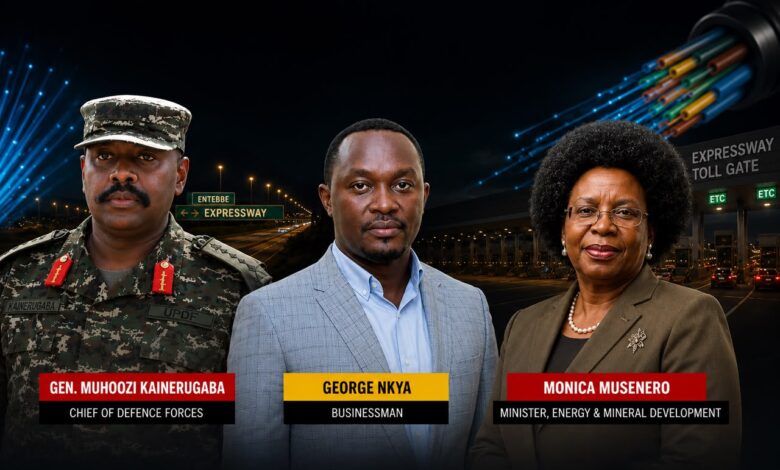
Businessman George Nkya, who is linked to Samanga Utilities Limited, Kilimanjaro Telecom and Wilken, is at the centre of an investigation into what officials describe as a years-long campaign to gain influence over Uganda’s critical internet infrastructure through a series of strategic telecommunications deals.
Investigators say the plan, if successful, would have placed companies associated with Nkya at the heart of both Uganda’s international internet gateway and its domestic fibre optic backbone, giving them significant commercial and operational influence over the country’s digital infrastructure.
The Tanzania Connection
Uganda secured US$150 million from the World Bank under the Uganda Digital Access Project, which included plans to establish an alternative international internet route through Dar es Salaam. While Uganda already accesses submarine cables through Kenya’s port of Mombasa, government sought a second route via Mutukula into Kampala to improve redundancy and reduce costs.
According to the investigation, Nkya allegedly leveraged political connections through Minister of Communication and Information Technologies for Tanzania to position Kilimanjaro Telecom as the preferred company to activate the fibre link from Dar es Salaam to Mutukula. Sources claim competing bidders were declared technically non-compliant, leaving Kilimanjaro Telecom as the successful bidder.
The investigation shows that after securing the Tanzanian segment, Nkya sought to extend the same arrangement into Uganda by influencing procurement processes at NITA-U.
Documents reviewed during the investigation indicate that the initial contract, estimated at US$4.5 million (about US$2 per Mbps), was later revised to approximately US$14 million, increasing the cost to nearly US$4.80 per Mbps.
The UETCL Fibre Ambition
The investigation, based on internal government documents, procurement records, official correspondence, contracts and interviews with senior government officials, also reveals Nkya’s attempt to secure control over the commercial management of Uganda Electricity Transmission Company Limited’s (UETCL) national fibre optic network.
Investigators describe the proposal as an ambitious effort to place a privately controlled Special Purpose Vehicle at the centre of Uganda’s national digital infrastructure.
The Museveni Directive
The proposal gained momentum following a 27 August 2025 directive issued by President Yoweri Museveni after meeting Tanzania’s Minister for Information and Communication Technology at State House Entebbe.
In the directive, the President instructed government agencies to explore routing Uganda’s internet traffic through Tanzania rather than Kenya, arguing that the Kenyan route was heavily driven by commercial interests and that Uganda should pursue long-term strategic value.
The presidential communication specifically mentioned Samanga Utilities Limited as a potential private-sector partner in proposals to connect Uganda’s transmission fibre network to Tanzania, develop new fibre corridors between Masaka and Kyaka and Mirama Hills and Kikagati, and commercialize fibre infrastructure along the East African Crude Oil Pipeline.
A 30-Year Concession
Following the directive, Samanga Utilities submitted an even broader proposal seeking a 20- to 30-year concession under a Special Purpose Vehicle wholly owned by the company.
The proposal went far beyond leasing fibre optic cables.
It sought commercial rights over;
Dark fibre
Indefeasible Rights of Use (IRUs)
Data centres
Cross-connect services
Tower and pylon rentals
Lit capacity
Fibre-to-the-Home (FTTH)
GPON broadband infrastructure
Under the arrangement, Samanga would serve as the project’s sponsor, developer, operator and commercial manager, effectively giving it extensive operational control over strategic national communications infrastructure.
Technical Experts Raise Red Flags
That proposal, however, met strong resistance from UETCL’s technical evaluators. An internal assessment completed in April 2026 concluded that Samanga’s proposal failed to meet key technical and commercial requirements and posed significant operational, financial and national security risks.
Among the findings;
No evidence that Samanga had the required 10 years’ experience managing fibre networks exceeding 3,000 kilometres.
No proof of comparable telecommunications projects worth at least UGX 15 billion completed since 2014.
Absence of internationally recognised certifications, including ISO 9001, ISO 27001 and ISO 45001.
Claimed partnerships with Liquid Intelligent Technologies, SEACOM and Nokia could not be independently verified.
Evaluators further warned that the proposed governance model would reduce UETCL to a passive asset owner while granting the private concessionaire broad commercial authority and favourable revenue-sharing arrangements.
The report also cautioned that such a concession could create monopoly concerns inconsistent with Uganda’s liberalised telecommunications market.
Government Steps In
The concerns ultimately prompted intervention by the Ministry of Energy and Mineral Development.
In July 2026, Minister Monica Musenero directed UETCL to halt the procurement process, submit all procurement and evaluation records to the ministry, and prepare a fresh Request for Proposals incorporating stronger governance, accountability and oversight mechanisms.
The directive effectively stopped Samanga’s proposal in its existing form.
Political Connections
The investigation also examines Nkya’s network of influential connections within Uganda’s political and security establishment. Sources allege that former Presidential Press Secretary Dr Kenneth Omona introduced Nkya to President Museveni, opening doors that later facilitated several telecommunications proposals.
Nkya has also been linked to former Chief of Defence Forces Gen. David Muhoozi, as well as officials within NITA-U. Investigators allege that relationships within these institutions helped smooth the path for several of the proposed transactions.
The investigation further claims Nkya cultivated ties with several senior military officers over the years before, according to sources, resistance emerged from within government that ultimately frustrated parts of the plan.
Previous Military Procurement Questions
Nkya’s name has also surfaced in previous investigations into proposed lawful military telecommunications interception equipment for the Uganda People’s Defence Forces.
The proposed contract reportedly shifted in value from US$141 million to US$40 million, before later being revised to approximately US$21 million.
Investigators reportedly found no evidence that the equipment was ever delivered, and the transaction later featured in inquiries involving Maj. Gen. James Birungi.
What else about Nkya?
The investigation has also drawn the attention of Uganda’s Chief of Defence Forces, Gen. Muhoozi Kainerugaba, who, according to sources familiar with the matter, has taken a keen interest in Nkya’s dealings. Investigators allege that the CDF is pursuing accountability over claims that Nkya exploited the President’s name and a presidential directive to influence government processes and secure lucrative public contracts.
Nkya was linked to the installation of lighting along the Kampala–Entebbe Expressway for the Non-Aligned Movement (NAM) Summit. Critics argue that much of the lighting has since failed, while others say the system never achieved the required illumination standards.
The investigation further states that companies associated with Nkya have expanded their footprint into other strategic public infrastructure, including operations related to Expressway toll collections, the Entebbe International Airport parking management system, and the Expressway electronic payment system.
In a series of public remarks, Gen. Muhoozi Kainerugaba has referred to Nkya as “the Tanzanian criminal,” underscoring the growing scrutiny surrounding the businessman and his business interests in Uganda.
Why It Matters
The findings emerge as Uganda rolls out its US$150 million World Bank-funded Digital Access Programme, designed to expand affordable internet access nationwide.
According to investigators, the documents reveal an attempt by one businessman to secure influence over both Uganda’s international internet gateway through Tanzania and the country’s domestic fibre backbone through UETCL.
Technical experts ultimately concluded that the proposed arrangements presented significant risks to national security, market competition, regulatory compliance and the long-term sustainability of Uganda’s strategic communications infrastructure.
If substantiated, the investigation raises fundamental questions about procurement oversight, governance and the protection of Uganda’s most critical digital assets.