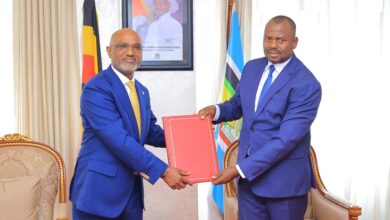


How a presidential directive to study proposals appears to have become a pathway for fresh deals linked to businessman George Nkya
Businessman George Nkya appears to have mastered a powerful formula in Uganda: get a proposal into government, secure high-level attention, and then work the system until the proposal begins to look like a government project.
Even as questions continue to surround his dealings and investigations into several of his business interests, documents obtained by Deep State show that proposals linked to his company, Samanga Utilities, have continued to find their way into the offices of senior government officials.
The latest documents raise an even bigger question: is Nkya simply taking advantage of government directives, or has he learned how to manipulate the machinery of government to turn presidential interest into commercial opportunities?
The President Did Not Award Him a Deal
A June 23, 2026 letter from President Yoweri Museveni to Prime Minister Robinah Nabbanja provides an important piece of the puzzle.
The letter, titled “Proposals from Samanga Utilities regarding an alternative internet route through Tanzania and automation and modernization of the Entebbe Express tolling system,” refers to proposals that included connecting Uganda to Tanzania’s internet system through Mutukula, using electricity transmission infrastructure and the petroleum pipeline corridor to create capacity for digital transmission, and automating toll collection on the Entebbe Expressway.
But significantly, the President did not award Samanga a contract.
Instead, he instructed government to study the proposals with the relevant ministers and recommend a course of action for each of them.
That distinction is critical.
The President’s letter was essentially a request for assessment, not an approval for Samanga to take control of strategic national infrastructure. Yet what followed shows how quickly such presidential correspondence can set the machinery of government in motion.
Ministers Start Moving
On July 8, Minister of ICT and National Guidance Kasule Lumumba Justine wrote to the Executive Director of NITA-U, explicitly referring to the President’s June 23 directive.
The minister demanded a comprehensive report on three proposals:
- Linking Uganda to the Tanzanian internet system through Mutukula
- Extending the National Backbone Infrastructure along the Petroleum Pipeline Corridor
- Automating toll collection on the Entebbe Expressway
The report, she said, was required before the Prime Minister convened a coordination meeting.
On paper, this is exactly what the President ordered: study the proposals and advise government. But the bigger story lies in what happened around these proposals and in how frequently Samanga appears to have remained at the centre of the conversation.
Three Strategic Assets
The proposals touch three pieces of infrastructure that are too important to be treated as ordinary commercial projects.
The first is Uganda’s international internet connectivity. Samanga proposed an alternative route through Tanzania, potentially giving Uganda another gateway for international internet traffic alongside the existing Kenyan route.
The second is the country’s fibre infrastructure. The proposals envisage using electricity transmission infrastructure and the petroleum pipeline corridor to expand digital transmission capacity.
The third is the Entebbe Expressway, where Samanga’s proposal includes automation of toll collection.
Together, these are not small contracts.
They touch Uganda’s internet gateway, national fibre infrastructure, and a major revenue-generating transport asset. And this is where the Nkya story becomes bigger than one businessman and one company.
The UETCL Setback
The Samanga proposals came at a time when another attempt to commercialize UETCL’s fibre optic business was already attracting scrutiny. UETCL eventually cancelled that procurement process, citing a significant change in the circumstances of the procurement.
The cancellation triggered a complaint from one of the bidders and subsequently brought the matter before Vice President Jessica Alupo, who convened senior officials to examine the circumstances surrounding the process.
The intervention has now reportedly resulted in a further halt to discussions pending a briefing to President Museveni. In other words, one door closed at UETCL, but proposals touching the same strategic fibre infrastructure continued moving through other channels.
The Nkya Pattern
This is where investigators are increasingly interested in Nkya’s methods. His name has surfaced across proposals involving internet connectivity, fibre infrastructure, tolling, and other strategic systems.
The concern is not simply that Nkya’s companies are bidding for government business. That is legitimate in itself.
The concern is whether political access, presidential directives, and relationships within government are being used to give those proposals an advantage before competitive and technical processes have been completed.
The documents currently available do not establish that the President personally endorsed Samanga for any of these deals. In fact, the June 23 letter points in the opposite direction: study the proposals and advise government.
The question, therefore, becomes what happens after the President issues such a directive.
- Who interprets it?
- Who implements it?
- Who prepares the technical reports?
- Who convenes the meetings?
- And, ultimately, who benefits?
Knowing Which Buttons to Press
Nkya’s critics say he has become adept at navigating this system. They allege that he knows which officials to approach, which institutions to engage, and, most importantly, how to invoke high-level government interest to keep his proposals alive.
That is what makes the documents obtained by Deep State significant.
They show a chain beginning with a presidential directive, moving through the Prime Minister’s office and ministries, and reaching agencies such as NITA-U, all concerning proposals originating from Samanga.
- The President asks for a study.
- The ministers ask for reports.
- Government agencies begin examining the proposals.
- Meetings are convened.
- And the businessman remains at the centre of the conversation.
The Bigger Risk
Uganda’s problem may therefore be bigger than whether Samanga wins or loses a particular contract.
It is whether strategic national infrastructure can gradually be placed in the hands of individuals who have mastered the art of navigating government systems.
Internet gateways, national fibre networks, and tolling systems are not ordinary commercial assets. They carry implications for national security, public revenue, competition, data sovereignty, and Uganda’s long-term economic interests.
If procurement and technical safeguards are weakened by political access, the country could eventually find itself dependent on private interests that have become too deeply embedded in strategic systems to easily remove.
And that is the uncomfortable question emerging from the Nkya files:
Is Uganda designing its digital future through transparent competition and independent technical assessment, or are individuals who know how to press the right buttons quietly designing it for us?
One Document, One Important Distinction
President Museveni’s June 23 letter does not hand Samanga a contract.
It asks government to study the proposals and recommend a course of action.
What happened after that directive, and who influenced the process that followed, is now the question that deserves the country’s attention.
Editor’s note: The June 23 letter reproduced in the documents contains an apparent date inconsistency: it says the President received a letter dated September 28, 2026, although the presidential letter itself is dated June 23, 2026. The discrepancy has been retained as it appears in the source document and requires clarification.